Showing posts with label culture. Show all posts

Tuesday, May 10, 2022

Safranbolu, Turkey

SAFRANBOLU (Turkey)

Between Ankara and the Black Sea sits Safranbolu. The Old Mosque, Bath, and Madrasa date to 1322, when it was a stop on a main caravan route; its name comes from "saffron," one of its foremost trade goods, which is still grown in the area. Its Old Town has 1008 registered historical artifacts: mosques, tombs, fountains, Turkish baths, and 100s of houses, as well as mounds with remains of ancient settlements.


Navigation:

(Image courtesy Wikimedia Commons; CTTO)

Wednesday, March 9, 2022

Grand-Pre Landscape, Canada

GRAND-PRE LANDSCAPE (Canada)

The Nova Scotia town of Grand-Pre ("Great Meadow") was the setting for Henry Wadsworth Longfellow's poem Evangeline. It's situated near a marshland displaying agricultural development using dykes and sluices in a system dating to the Acadians of the 17th century. Archaeological sites reveal the origins of European settlement on the North American Atlantic coast.


Navigation:

(Image courtesy Wikimedia Commons; CTTO)

Saturday, March 5, 2022

The Khomani Cultural Landscape, South Africa

THE KHOMANI CULTURAL LANDSCAPE (South Africa)

Located on the South Africa/Botswana border near Namibia, this area contains evidence of human occupation from the Stone Age to the present. The culture of the formerly nomadic Khomani and related San people adapted to this harsh landscape, which bears testimony to their ethos of living softly on the land as part of nature over thousands of years.


Navigation:

(Image courtesy Wikimedia Commons; CTTO)

Saturday, February 19, 2022

Levuka Port Town, Fiji

LEVUKA PORT TOWN (Fiji)

Tiny Levuka on the island of Ovalau was the capital of Fiji until 1877. Today it's an exceptional example of late colonial port towns in the Pacific. Its low line of buildings among coconut and mango trees along the beach front was used by Americans and Europeans who were always outnumbered by the indigenous community, ensuring the integration of local building traditions.


Navigation:

(Image courtesy Wikimedia Commons; CTTO)

Saturday, February 5, 2022

Tongariro National Park, New Zealand

TONGARIRO NATIONAL PARK (New Zealand)

The world's sixth-oldest national park is in the center of New Zealand's North Island. It contains three volcanoes: Ruapehu, Ngauruhoe, and the titular Tongariro. Much of the landscape is sacred to the Maori people, symbolizing the spiritual links between this community and its environment: it was the UNESCO World Heritage List's first "cultural landscape."

(Image courtesy Wikimedia Commons; CTTO)


Tuesday, November 30, 2021

The Panama Canal

THE PANAMA CANAL (Panama, Central America)

This "wonder of the modern world" joins the Atlantic and Pacific Oceans, dividing North and South America. Considered one of history's most difficult engineering projects, its system of locks eliminated the need for shipping "around the Horn" of South America. France began the work in 1881; the U.S. finished it in 1914. It is now controlled by the Panamanian government.

(Image courtesy Wikimedia Commons; CTTO)


Monday, November 29, 2021

The Paris Sewers

THE PARIS SEWERS (Paris, France)

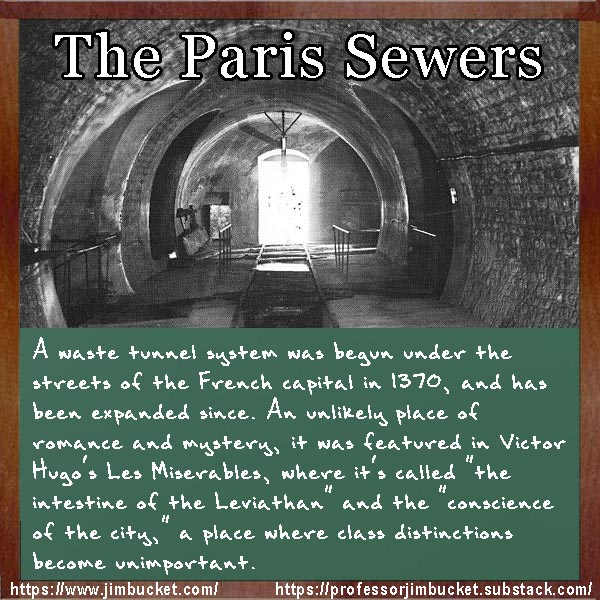
A waste tunnel system was begun under the streets of the French capital in 1370, and has been expanded since. An unlikely place of romance and mystery, it was featured in Victor Hugo's Les Misérables, where it's called "the intestine of the Leviathan" and the "conscience of the city," a place where class distinctions become unimportant.

(Image courtesy Wikimedia Commons; CTTO)

Sunday, November 28, 2021

The Leaning Tower of Pisa

THE LEANING TOWER OF PISA (Pisa, Tuscany, Italy)

Nearly 186 feet high (on the high side), the freestanding bell tower of Pisa Cathedral is famous for its nearly 4° lean. The foundation was improperly laid over soft ground; the lean began during construction. At its worst it was 5.5°; it was straightened 1993-2001. Galileo famously (if apocryphally) used the tilt to drop cannon balls in demonstrating the law of free fall.

(Image courtesy Wikimedia Commons; CTTO)


Saturday, November 27, 2021

The Great Sphinx of Giza

THE GREAT SPHINX OF GIZA (Giza, Egypt)

This limestone statue of a reclining lion's body with a man's head--a symbol of mystery--has been gazing away from the Great Pyramids at Giza on an east-west line for four and a half millennia. Carved from the bedrock of the plateau, it is 240 feet long and 66 feet high. It may once have worn a long pharaonic beard and been painted bright colors.

(Image courtesy Wikimedia Commons; CTTO)


Friday, November 26, 2021

The Golden Gate Bridge

THE GOLDEN GATE BRIDGE (San Francisco, California, USA)

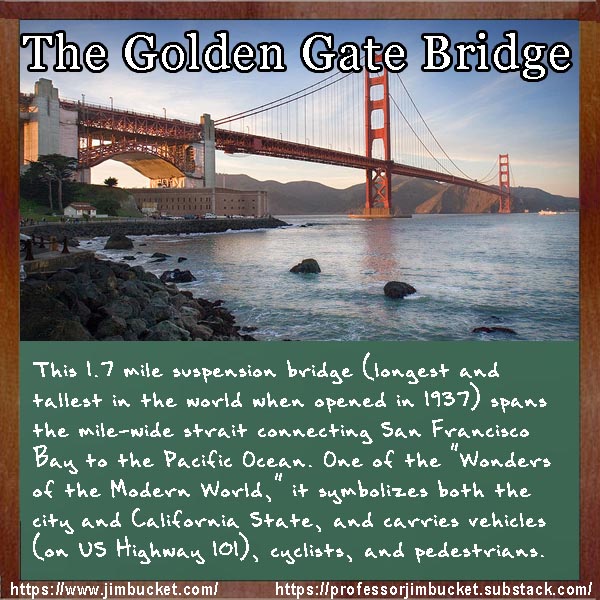
This 1.7-mile suspension bridge (longest and tallest in the world when opened in 1937) spans the mile-wide strait connecting San Francisco Bay to the Pacific Ocean. One of the "Wonders of the Modern World," it symbolizes both the city and California State, and carries vehicles (on US Highway 101), cyclists, and pedestrians.

(Image courtesy Wikimedia Commons; CTTO)

Thursday, November 25, 2021

El Camino de Santiago

EL CAMINO DE SANTIAGO (Compostela, Spain)

One of the "Big Three" Catholic pilgrimages (alongside Jerusalem and Rome), this 500-mile network of paths from the French border in the Pyrenees to the supposed burial place of St. James the Apostle at Compostela has been traveled for over 1,000 years. Today the 200,000+ trekkers annually include not only the religious, but also hikers and cyclists.

(Image courtesy Wikimedia Commons; CTTO)


Tuesday, November 23, 2021

The Old City of Jerusalem

THE OLD CITY OF JERUSALEM (Jerusalem, Israel)

A third of a mile square, core of the modern city and a hotbed of religious activity for millennia, at least since the days when it was called "The City of David" (yes, THAT David). Home to Temple Mount and Western Wall (Jews), Church of the Holy Sepulchre (Christians), and Dome of the Rock and al-Aqsa Mosque (Muslims).

(Image courtesy Wikimedia Commons; CTTO)


Monday, November 22, 2021

The Transcontinental Railroad

THE TRANSCONTINENTAL RAILROAD (Missouri River to San Francisco Bay)

The first railway from the Atlantic to the Pacific Oceans was built between 1863 and 1869. From the existing East Coast rail network at the Missouri River, it stretched 1,912 miles (3,077 kilometers) to San Francisco Bay. Construction began at both ends--east and west--and met in Utah at Promontory Summit, where a ceremonial "Golden Spike" was driven.

(Image courtesy Wikimedia Commons; CTTO)


Sunday, November 21, 2021

The Alhambra

THE ALHAMBRA (Granada, Andalusia, Spain)

This Spanish palace/fortress's name is Arabic for "The Red One." Begun in 1238 by a Muslim emir, it sits on the site of earlier fortresses on an outcrop of the Sierra Nevada in Granada, Andalusia. It has been continuously modified; after the Christians retook Spain in 1492, it became the Royal Court of Ferdinand and Isabella, where they received Christopher Columbus.

(Image courtesy Wikimedia Commons; CTTO)


Saturday, November 20, 2021

The Potala Palace

THE POTALA PALACE (Lhasa, Tibet)

Home to Dalai Lamas 1649-1959 (now a museum), this 13-story symbol of Tibetan Buddhism in the Lhasa Valley stands on a site used for this purpose since 637. Its namesake, Mount Potalaka, is the mythical abode of Bodhisattva Avalokiteshvara, of whom the Dalai Lama is believed to be a reincarnation. It has over 1,000 rooms, 10,000 shrines, and about 200,000 statues.

(Image courtesy Wikimedia Commons; CTTO)


Friday, November 19, 2021

The Sydney Opera House

THE SYDNEY OPERA HOUSE (Sydney, Australia)

This 1973 "urban sculpture" at the tip of a peninsula projecting into Sydney Harbour is made of groups of interlocking sail-shaped shells housing two main performance halls and several smaller ones, plus a recording studio and a restaurant. Taking 15 years to build, many of them swamped in controversy, at last it stands as tall as a 22-story building.

(Image courtesy Wikimedia Commons; CTTO)


Thursday, November 18, 2021

Angkor Wat

ANGKOR WAT (Siem Reap, Cambodia)

This originally Hindu temple complex, now an important Buddhist pilgrimage site, centers on four towers circling a fifth that is 213 feet (65 meters) tall. Surrounded by three tiered galleries bearing extensive bas-reliefs, and two moats, the whole represents Mount Meru of Indian cosmology. Built in the early 12th century, it now appears on Cambodia's national flag.

(Image courtesy Wikimedia Commons; CTTO)


Wednesday, November 17, 2021

Mount Everest

MOUNT EVEREST (Nepal/Tibet border)

The Tibetan name of this highest mountain in the world--Qomolangma--means "Holy Mother." Standing on the Nepal-Tibet (China) border 29,031.7 feet (8,848.86 meters) above sea level, its English name--"Everest," after a British surveyor who objected to this naming--has become a metaphor for the highest goal we can set for ourselves "because it's there."

(Image courtesy Wikimedia Commons; CTTO)


Tuesday, November 16, 2021

The Empire State Building

THE EMPIRE STATE BUILDING (New York, New York, USA)

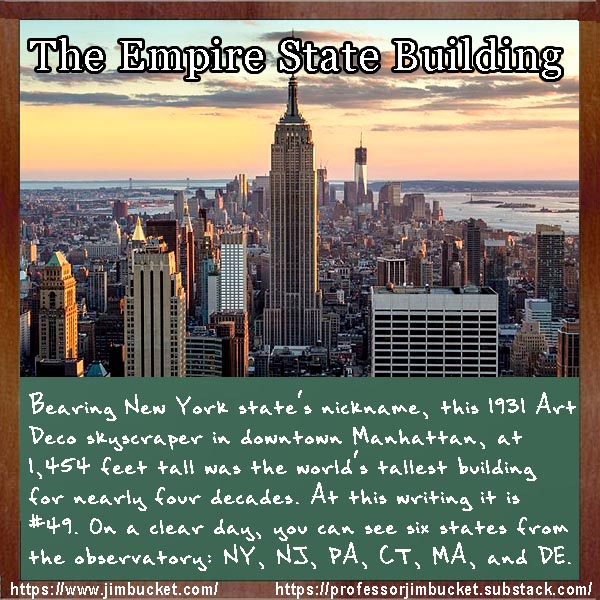
Bearing New York state's nickname, this 1931 Art Deco skyscraper in downtown Manhattan, at 1,454 feet tall was the world's tallest building for nearly four decades. At this writing it is #49. On a clear day, you can see six states from the observatory: NY, NJ, PA, CT, MA, and DE.

(Image courtesy Wikimedia Commons; CTTO)

Monday, November 15, 2021

The Taj Mahal

THE TAJ MAHAL (Agra, India)

This ethereal edifice on the banks of the River Yamuna in Agra, India, is actually a mausoleum. A "monument to undying love," it was built from 1632-53 by the Muslim emperor Shah Jahan for his favorite wife, Mumtaz Mahal, who died giving birth to the couple's 14th child. Shah Jahan himself is also buried there. Estimated cost in today's money: $1 billion US.

(Image courtesy Wikimedia Commons; CTTO)