Showing posts with label Asia. Show all posts

Wednesday, May 4, 2022

Tubbataha Reefs Natural Park, The Philippines

TUBBATAHA REEFS NATURAL PARK (The Philippines)

Tubbataha Reefs Natural Park (from two Sama-Bajau words meaning "a long reef exposed at low tide") are a marine and bird sanctuary in the middle of the Sulu Sea consisting of two huge atolls and a smaller reef, covering 374.6 square miles. With its very high density of marine species (and serving as a nesting site for birds and marine turtles), it is an excellent example of a pristine coral reef.


Navigation:

(Image courtesy Wikimedia Commons; CTTO)

Saturday, April 23, 2022

Slopes of the Himalayas, Uttarakhand, India

SLOPES OF THE HIMILAYAS, UTTARAKHAND (INDIA)

High in West Himalayas, Nanda Devi National Park in Uttarakhand, India, features rugged mountainous terrain; the annexed Valley of Flowers has meadows of alpine flowers and outstanding natural beauty. A richly diverse area, it is home to Asiatic black bears, snow leopards, brown bears, and blue sheep. Together they encompass a unique transition zone.


Navigation:

(Image courtesy Wikimedia Commons; CTTO)

Friday, March 25, 2022

Ayutthaya, Thailand

AYUTTHAYA (Thailand)

Located on an island at the confluence of two rivers, "Old" Ayutthaya was founded in 1351 by the king of ancient Siam, who fled there to escape smallpox in his previous capital. The city (and the kingdom) collapsed when the Burmese army destroyed it in 1767, leaving magnificent ruins. Nearby modern Ayutthaya (then named Rop Krung Kao) was created in 1897.


Navigation:

(Image courtesy Wikimedia Commons; CTTO)

Thursday, March 10, 2022

Fatehpur Sikri, India

FATEHPUR SIKRI, India

Fatehpur Sikri (the "City of Victory") stands about 25 miles from the Taj Mahal, and served as the capital of the Mughal Empire 1571-1585 under its builder, Emperor Akbar the Great (son and successor to Humayun, and grandfather of the builder of the Taj). It is home to numerous exquisite buildings, including the Buland Darwaza (shown), gateway to the congregational mosque.


Navigation:

(Image courtesy Wikimedia Commons; CTTO)

Monday, February 28, 2022

Tidal Flats (Getbol), South Korea, Asia

TIDAL FLATS ("GETBOL") (South Korea)

Inscribed in the UNESCO List in 2021, these four areas in SW Korea feature four different types of tidal flats (estuarine, open embayed, archipelago, and semi-enclosed). Together they cover about 500 square miles and are home to 2,150 species of flora and fauna, 22 of which are threatened to some degree. They are also on the East Asia Flyway for migratory birds.


Navigation:

(Image courtesy Wikimedia Commons; CTTO)

Sunday, February 27, 2022

Ruins of Ani, Armenia (Turkey)

RUINS OF ANI (Armenia, now Turkey)

On a secluded plateau in NE Turkey, by a ravine forming a natural border with Armenia, stand the ruins of Ani, at one time the capital of the Bagratid Armenian kingdom (880s-1045) that covered much of today's Armenia and E Turkey. Ani was called the "City of 1,001 Churches" (not really), and was once one of the world's largest cities, with well over 100,000 people.


Navigation:

(Image courtesy Wikimedia Commons; CTTO)

Thursday, February 24, 2022

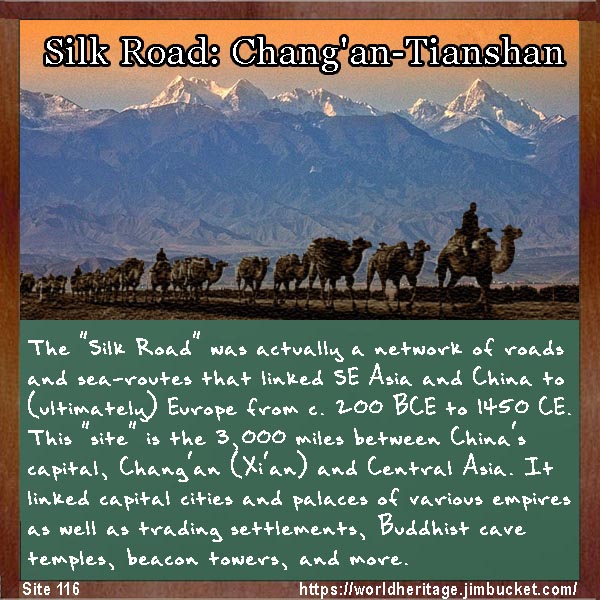
Silk Roads: Chang'an-Tianshan - China, Kazakhstan, Kyrgyzstan

SILK ROAD: CHANG'AN-TIANSHAN (China, Kazakhstan, Kyrgyzstan)

The "Silk Road" was actually a network of roads and sea-routes that linked SE Asia and China to (ultimately) Europe from c. 200 BCE to 1450 CE. This "site" is the 3,000 miles between China's capital, Chang'an (Xi'an) and Central Asia. It links capital cities and palaces of various empires as well as trading settlements, Buddhist cave temples, beacon towers, and more.


Navigation:

(Image courtesy Wikimedia Commons; CTTO)
Sunday, February 20, 2022

The Kong Family Mansion, Qufu, China


KONG FAMILY MANSION, QUFU (China)

In Qufu, his hometown, stands the grave of Kong Fuzi, known to us as Confucius. Nearby is a temple and a 134,200 square foot mansion of 480 rooms in 152 buildings, where his family lived for generations (it is now a museum) and from which they once governed the largest private rural estate in China. The cemetery where he lies also holds over 100,000 of his descendants.


Navigation:

(Image courtesy Wikimedia Commons; CTTO)

Sunday, February 13, 2022

The Chengjiang Fossil Site, China

THE CHENGJIANG FOSSIL SITE (China)

This area in Southwestern China has sedimentary deposits containing soft-tissue fossils from a very wide variety of invertebrate and vertebrate organisms from perhaps 530 million years ago. First discovered by a couple of French paleontologists in 1912, they're threatened by the economic need to exploit nearby phosphates in this underdeveloped area.


Navigation:

(Image courtesy Wikimedia Commons; CTTO)

Tuesday, February 1, 2022

Humayun's Tomb, Delhi, India

HUMAYUN'S TOMB (Delhi, India)

This tomb, completed in Delhi in 1570, was the first Persian-style garden tomb built in the Indian subcontinent, and the first to use red sandstone at such a scale. It entombs the second Mughal Emperor; the fifth, Shah Jahan, completed the Taj Mahal for his wife Mumtaz 80 years later. Other important tombs are found near that of Humayun.

(Image courtesy Wikimedia Commons; CTTO)


Saturday, January 29, 2022

Changdeokgung Palace, South Korea

CHANGDEOKGUNG PALACE (Seoul, South Korea)

This 15th-century complex comprises official and residential buildings set in a large park in Seoul, South Korea. Noted for the buildings' blending in with the natural topography of the site instead of imposing themselves upon it, only about 30% of the pre-Japanese structures have survived the damages of the Japanese occupation of Korea (1910–1945).

(Image courtesy Wikimedia Commons; CTTO)


Sunday, January 16, 2022

Mongolian Altai Petroglyphs

MONGOLIAN ALTAI PETROGLYPHS (western Mongolia)

This six-square-mile region on the south side of western Mongolia's White River Valley contains figures of roughly 10,000 wild and domestic animals, some dating back more or less 10,000 years, and depicting the Altai peoples' transition from hunting to domestic herding and on to the nomadic horse-based culture popularly associated with the much later Genghis Khan.

(Image courtesy Wikimedia Commons; CTTO)


Saturday, January 8, 2022

Ruins of the Buddhist Vihara at Paharpur

SOMAPURA MAHAVIHARA (Paharpur, northwest Bangladesh)

This ruins complex (8th-13th century CE) in NW Bangladesh was one of the five great Buddhist universities in the Indian subcontinent. The Chinese pilgrim Xuanzang stayed here; Atisha launched his mission to Tibet from here. Today it is one of the most important archaeological sites in the country.

(Image courtesy Wikimedia Commons; CTTO)


Tuesday, January 4, 2022

Kiyomizudera

KIYOMIZUDERA (Kyoto, Japan)

This Buddhist temple, whose name means "clear water," has a waterfall on the grounds. The dramatic location hanging off a hillside in eastern Kyoto, Japan, provides spectacular views of the city. Legend says jumping the 43 feet off the veranda--and surviving--grants wishes. 234 tried in the Edo period; 85.4% survived. The practice was prohibited in 1872.

(Image courtesy Wikimedia Commons; CTTO)


Friday, December 31, 2021

Mount Fuji

MOUNT FUJI (southwest of Tokyo, Japan)

At 12,389.2 feet the highest mountain in Japan (and 7th-highest island peak on earth), this active volcano last erupted 1707-1708. A cultural icon of Japan, it is also a sacred peak which has "inspired artists and poets and been the object of pilgrimage for centuries" (UNESCO). It's climbed by around 300,000 hikers and pilgrims yearly.

(Image courtesy Wikimedia Commons; CTTO)


Tuesday, December 28, 2021

The Great Rift Valley

THE GREAT RIFT VALLEY (Lebanon to Mozambique)

The Great Rift Valley is a 4,300-mile-long series of trenches that runs from Lebanon (in Asia) to Mozambique (in Africa). Tanzania's 30-mile-long Olduvai Gorge leading into the Rift is the site of some of the world's most important "early man" finds, associated with the team of Mary and Louis Leakey (prominent in the "National Geographic" when I was a kid).

(Image courtesy Wikimedia Commons; CTTO)


Friday, December 24, 2021

Ha Long Bay

HA LONG BAY (Vietnam)

Meaning "descending dragon," this bay features thousands of limestone karsts and isles in various shapes and sizes, the result of 20 million years of geological evolution. A famous Vietnamese poet called it "rock wonder in the sky." During the Vietnam War, the US Navy placed mines between some islands, some of which continue to pose a threat to shipping.

(Image courtesy Wikimedia Commons; CTTO)


Monday, December 20, 2021

Vigan, Philippines

VIGAN, PHILIPPINES (Vigan,  Ilocos Sur, Philippines)

Originally "Bee Gan," Beautiful Shore in a dialect of the Chinese who first settled the area, this Filipino town of Spanish colonial architecture remains true to its name. Ancient structures, cobbled streets, horse-drawn carriages, and the central plaza in front of the Baroque church recall an earlier day.

(Image courtesy Wikimedia Commons; CTTO)


Friday, December 17, 2021

Jeju Island

JEJU ISLAND (South Korea)

The largest island in South Korea lies below the Korean Peninsula in the Korea Strait. Formed 2,000,000 years ago by an underwater volcanic eruption, its Hallasan volcano at 6,400 feet is the highest mountain in South Korea. Lava tube caves and other such attractions make it a popular holiday destination and a UNESCO natural world heritage site.

(Image courtesy Wikimedia Commons; CTTO)


Tuesday, December 14, 2021

The Great Wall of China

THE GREAT WALL OF CHINA (China)

Actually a series of overlapping walls, it protected the northern borders of China from "barbarian" invaders; some entered anyway and founded dynasties (Yuan, Qing). Total length was around 12,000 miles. What we see today is mostly rammed earth; brick and stone portions have been salvaged for building materials. And no, it cannot be seen from the moon.

(Image courtesy Wikimedia Commons; CTTO)