Showing posts with label China. Show all posts

Friday, May 20, 2022

Peking Man Site, Zhoukoudian, China

PEKING MAN SITE, ZHOUKOUDIAN (China)

In 1921 Swedish geologist Johan Gunnar Andersson discovered a cave complex about 25 miles SW of Beijing that yielded "Peking Man," a subspecies of Homo erectus. When exactly "he" lived in the area is unclear: sometime between 780,000 and 230,000 years ago. Virtually all specimens (found before 1941) were lost when a shipment was attacked by Japanese warships.


Navigation:

(Image courtesy Wikimedia Commons; CTTO)

Saturday, April 30, 2022

Taishan, China

TAISHAN (China)

Mount Tai (Taishan) is the eastern mountain of China's Five Sacred Mountains, signifying birth and renewal. It is considered sacred to both Buddhism and Taoism, and has been a site of religious activities for at least three millennia. It is also the highest point in China's Shandong Province.


Navigation:

(Image courtesy Wikimedia Commons; CTTO)

Saturday, April 16, 2022

Longmen Grottoes, Henan, China

LONGMEN GROTTOES (Henan, China)

Located in the narrow "Dragon's Gate" (Ch. Longmen) along a half-mile stretch of the Yi River outside of the ancient capital of Luoyang, in China's Henan Province, this collection of over 100,000 statues (ranging from 1" to 57' high) and 2,345 artificial caves contains some of the finest examples of Chinese Buddhist carving, with the oldest dating back to 493 CE.


Navigation:

(Image courtesy Wikimedia Commons; CTTO)

Sunday, March 20, 2022

The Summer Palace, Beijing, China

THE SUMMER PALACE, BEIJING (China)

Beijing's Summer Palace was an imperial garden in the Qing dynasty, and today is an ensemble of lakes, gardens and palaces a little over a square mile, most of it covered with water features. A 200-foot hill (made from soil acquired when excavating the central lake) has halls and pavilions on one side, and quiet natural beauty on the other.


Navigation:

(Image courtesy Wikimedia Commons; CTTO)

Thursday, March 3, 2022

Tusi Sites, China, Asia

TUSI SITES (China)

From the Yuan to the Qing dynasties, the Chinese government appointed local hereditary chieftains, called tusi, to govern the ethnic groups living in China's remote SW region. As you can imagine, some of them amassed quite a bit of power, and built "fortresses" from which to govern. Three of these, in Hubei, Hunan, and Guizhou Provinces, have been listed by UNESCO.


Navigation:

(Image courtesy Wikimedia Commons; CTTO)

Thursday, February 24, 2022

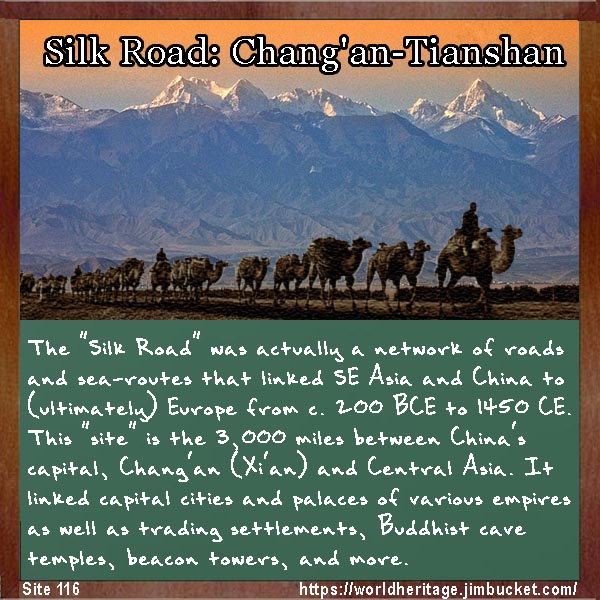
Silk Roads: Chang'an-Tianshan - China, Kazakhstan, Kyrgyzstan

SILK ROAD: CHANG'AN-TIANSHAN (China, Kazakhstan, Kyrgyzstan)

The "Silk Road" was actually a network of roads and sea-routes that linked SE Asia and China to (ultimately) Europe from c. 200 BCE to 1450 CE. This "site" is the 3,000 miles between China's capital, Chang'an (Xi'an) and Central Asia. It links capital cities and palaces of various empires as well as trading settlements, Buddhist cave temples, beacon towers, and more.


Navigation:

(Image courtesy Wikimedia Commons; CTTO)
Sunday, February 20, 2022

The Kong Family Mansion, Qufu, China


KONG FAMILY MANSION, QUFU (China)

In Qufu, his hometown, stands the grave of Kong Fuzi, known to us as Confucius. Nearby is a temple and a 134,200 square foot mansion of 480 rooms in 152 buildings, where his family lived for generations (it is now a museum) and from which they once governed the largest private rural estate in China. The cemetery where he lies also holds over 100,000 of his descendants.


Navigation:

(Image courtesy Wikimedia Commons; CTTO)

Sunday, February 13, 2022

The Chengjiang Fossil Site, China

THE CHENGJIANG FOSSIL SITE (China)

This area in Southwestern China has sedimentary deposits containing soft-tissue fossils from a very wide variety of invertebrate and vertebrate organisms from perhaps 530 million years ago. First discovered by a couple of French paleontologists in 1912, they're threatened by the economic need to exploit nearby phosphates in this underdeveloped area.


Navigation:

(Image courtesy Wikimedia Commons; CTTO)

Monday, January 17, 2022

The Mogao Caves

THE MOGAO CAVES (western China)

Also called the "Thousand Buddha Grottoes," these 735 or so decorated caves are carved along a two-kilometer-long cliff face near Dunhuang on western China's Silk Road. The first caves were dug out in 366 CE (the last around 1368) for Buddhist meditation and worship. An important document cache was found in 1900 in the walled-up "Library Cave."

(Image courtesy Wikimedia Commons; CTTO)


Tuesday, December 14, 2021

The Great Wall of China

THE GREAT WALL OF CHINA (China)

Actually a series of overlapping walls, it protected the northern borders of China from "barbarian" invaders; some entered anyway and founded dynasties (Yuan, Qing). Total length was around 12,000 miles. What we see today is mostly rammed earth; brick and stone portions have been salvaged for building materials. And no, it cannot be seen from the moon.

(Image courtesy Wikimedia Commons; CTTO)


Saturday, November 20, 2021

The Potala Palace

THE POTALA PALACE (Lhasa, Tibet)

Home to Dalai Lamas 1649-1959 (now a museum), this 13-story symbol of Tibetan Buddhism in the Lhasa Valley stands on a site used for this purpose since 637. Its namesake, Mount Potalaka, is the mythical abode of Bodhisattva Avalokiteshvara, of whom the Dalai Lama is believed to be a reincarnation. It has over 1,000 rooms, 10,000 shrines, and about 200,000 statues.

(Image courtesy Wikimedia Commons; CTTO)


Wednesday, November 17, 2021

Mount Everest

MOUNT EVEREST (Nepal/Tibet border)

The Tibetan name of this highest mountain in the world--Qomolangma--means "Holy Mother." Standing on the Nepal-Tibet (China) border 29,031.7 feet (8,848.86 meters) above sea level, its English name--"Everest," after a British surveyor who objected to this naming--has become a metaphor for the highest goal we can set for ourselves "because it's there."

(Image courtesy Wikimedia Commons; CTTO)