Showing posts with label architecture. Show all posts

Wednesday, May 25, 2022

Old Kotor, Montenegro

OLD KOTOR (Montenegro)

The Montenegrin town of Kotor's Venetian period fortifications include city walls, gates, and ramparts which protect the Old Town, parts of which date back to Roman and Byzantine times. The medieval portions include an 1166 cathedral. The inner bay of Kotor, an inlet of the Adriatic, has surrounding mountains, islets, and towns aside from Kotor.


Navigation:

(Image courtesy Wikimedia Commons; CTTO)

Tuesday, May 24, 2022

Aapravasi Ghat, Maritius

AAPRAVASI GHAT (Maritius)

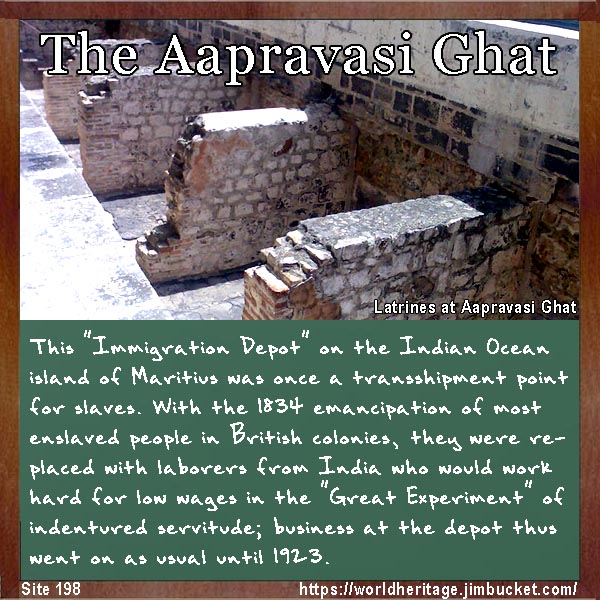
This "Immigration Depot" on the Indian Ocean island of Maritius was once a transshipment point for slaves. With the 1834 emancipation of most enslaved people in British colonies, they were replaced with laborers from India who would work hard for low wages in the "Great Experiment" of indentured servitude; business at the depot thus went on as usual until 1923.


Navigation:

(Image courtesy Wikimedia Commons; CTTO)
Wednesday, May 18, 2022

Three Squares in Nancy, France

THREE SQUARES IN NANCY (France)

Stanislaw I lived in the French city of Nancy when, after abdicating the throne of Poland, he became Duke of Lorraine. In the last 30 years of his life he devoted himself to science and philanthropy, founding an institute, a library, and more, and building three magnificent squares: Place Stanislas, Place de la Carrière and Place d'Alliance, all now inscribed on the UNESCO list.


Navigation:

(Image courtesy Wikimedia Commons; CTTO)

Monday, May 16, 2022

The Tomb of Ahmed Yasawi, Turkestan, Kazakhstan

THE TOMB OF AHMED YASAWI (Turkestan, Kazakhstan)

Sufi saint, poet, and mystic Khawaja Ahmed Yasawi died in Turkestan in 1166. Over 220 years later, in 1389, the Turco-Mongol conqueror Timur (sometimes called Tamerlane) replaced his modest 12th-century mausoleum with a magnificent structure in the Timurid style, featuring vault-and-dome and glazed tiles. It remains uncompleted since the death of Timur in 1405, but continues to draw pilgrims.


Navigation:

(Image courtesy Wikimedia Commons; CTTO)

Thursday, May 12, 2022

Christiansfeld, Denmark

CHRISTIANSFELD (Denmark)

This town of 3,008 souls in Southern Denmark was founded by the Moravian Church in 1773 and named for Danish King Christian VII, who supported the town's construction. Its one- or two-story homogeneous buildings surround a central Church Square bordered by two parallel streets; it is the best-preserved example of the Church's town-planning and architecture.


Navigation:

(Image courtesy Wikimedia Commons; CTTO)

Wednesday, May 11, 2022

Rohtas Fort, Pakistan

ROHTAS FORT (Pakistan)

The 16th-century Rohtas Fort is located near Jhelum in Punjab province. Never taken by force, and remarkably intact, it is one of the largest and most formidable in the subcontinent. Built by the founder of the Suri Empire partly to suppress local tribes loyal to the Mughals, it is known for its large walls and monumental gateways, an exceptional example of Muslim military architecture.


Navigation:

(Image courtesy Wikimedia Commons; CTTO)

Tuesday, May 10, 2022

Safranbolu, Turkey

SAFRANBOLU (Turkey)

Between Ankara and the Black Sea sits Safranbolu. The Old Mosque, Bath, and Madrasa date to 1322, when it was a stop on a main caravan route; its name comes from "saffron," one of its foremost trade goods, which is still grown in the area. Its Old Town has 1008 registered historical artifacts: mosques, tombs, fountains, Turkish baths, and 100s of houses, as well as mounds with remains of ancient settlements.


Navigation:

(Image courtesy Wikimedia Commons; CTTO)

Monday, May 9, 2022

Venice, Italy

VENICE (Italy)

Founded in the 5th century, this romantic city's famed canals divide it into 118 small islands linked by over 400 bridges, including the Rialto. The city sits in, not by, its renowned lagoon. In the 10th century proximity to Asia made it a maritime powerhouse; it is now an architectural masterpiece adorned by some of the world's greatest artists: Titian, Tintoretto, Veronese, and others.


Navigation:

(Image courtesy Wikimedia Commons; CTTO)

Thursday, May 5, 2022

Saint Sophia Cathedral, Kyiv, Ukraine

SAINT SOPHIA CATHEDRAL (Kyiv, Ukraine)

Begun in the early 11th century, Saint Sophia Cathedral in Kyiv is one of the city's best known landmarks, built to rival that other Saint Sophia in Constantinople. The cathedral complex includes a bell tower and monastery buildings. Nearby is the 1051 Kiev Monastery of the Caves (Pechersk Lavka), which includes numerous churches as well as cave systems and fortified stone walls.


Navigation:

(Image courtesy Wikimedia Commons; CTTO)

Thursday, April 28, 2022

Westminster, London, England

WESTMINSTER (London, England)

London's Westminster Abbey was built in 1245 where a church had been since the 7th century. All coronations have been held there since 1066, and 16 royal weddings since 1100. Over 3,300 prominent people--monarchs, prime ministers, poets, actors, scientists--are buried there. Nearby Westminster Palace (with its "Big Ben" Clock Tower) was first built in 1016 and rebuilt 1840-1876. It was the primary residence of English monarchs until 1512; Parliament has met there since the 13th century.


Navigation:

(Image courtesy Wikimedia Commons; CTTO)

Wednesday, April 27, 2022

Campeche Fort, Mexico

CAMPECHE FORT (Mexico)

Campeche City on the western side of Mexico's Yucatan Peninsula was founded in 1540 by Spanish conquistadores on the site of a pre-existing Maya city; that Pre-Columbian city had 3,000 houses and various monuments, but little of it remains. The Spaniards lived inside the preserved city walls, which protected it from pirates, while the natives lived outside, where their churches still stand.


Navigation:

(Image courtesy Wikimedia Commons; CTTO)

Monday, April 25, 2022

The Medina of Sousse, Tunisia

THE MEDINA OF SOUSSE (Tunisia)

Sousse is located about 90 miles south of Tunis, capital of Tunisia, along the Mediterranean coast. Once a Phoenician trading post in the classical period, its medina or walled city was built at the dawn of Islamic civilization, and features a Kasbah (fortress), ramparts, and a Grand Mosque. Today it houses an Archaeological Museum containing inscriptions from the time of Carthage.


Navigation:

(Image courtesy Wikimedia Commons; CTTO)

Sunday, April 24, 2022

The Castles at Bruhl, Germany

THE CASTLES AT BRUHL (Germany)

The Augustusburg and Falkenlust Palaces were built at Bruhl in west-central Germany at the start of the 18th century. The three-story Augustusburg Palace forms a U, and was once home to the prince-archbishops of Cologne. It was built in 1725 on the foundations of a medieval castle. Falkenlust was built between 1729 and 1737 as a hunting lodge.


Navigation:

(Image courtesy Wikimedia Commons; CTTO)

Thursday, April 21, 2022

Alcalá de Henares, Spain, and its University

ALCALA DE HENARES AND ITS UNIVERSITY (Spain)

22 miles NE of Madrid, Alcalá de Henares is the hometown of Cervantes. In its Historic Precinct stands the refounded (in 1977) University of Alcalá, which dates to the 13th century. Some of its buildings were once part of the equally-old Complutense University, which relocated to Madrid in 1836. Alcalá itself was founded in Roman times, and was once a Muslim citadel of al-Andalus.


Navigation:

(Image courtesy Wikimedia Commons; CTTO)

Wednesday, April 20, 2022

Puebla, Mexico

PUEBLA (Mexico)

The Mexican city of Puebla was founded in 1531 in an uninhabited spot about 60 miles east of Mexico City (which itself was conquered only a decade earlier), at the foot of the Popocatepetl volcano. Its historic center is home to fine old religious architecture, including a cathedral, an archbishop's palace, and many more, as well as houses covered in tiles.


Navigation:

(Image courtesy Wikimedia Commons; CTTO)

Tuesday, April 19, 2022

Warsaw Old Town, Poland

WARSAW OLD TOWN (Poland)

The oldest part of Warsaw, capital of Poland, sits on the bank of the Vistula river, and is one of the most prominent tourist attractions in the city. At its heart is the Old Town Market Place, home to restaurants, cafés, and shops. The streets feature medieval architecture such as the city walls; St. John's Cathedral; and the Barbican, a historic fortification.


Navigation:

(Image courtesy Wikimedia Commons; CTTO)

Sunday, April 17, 2022

The Cité de Carcassonne, France

THE CITE DE CARCASSONNE (France)

The Cité de Carcassonne is a medieval citadel located in the southern French city on a hill that has been fortified since the pre-Roman period. It was restored at the end of the 19th century; with its massive defenses encircling the castle, the surrounding buildings, the streets, and the Gothic cathedral, it is an exceptional example of a medieval fortress town.


Navigation:

(Image courtesy Wikimedia Commons; CTTO)

Friday, April 15, 2022

The Genbaku Dome, Hiroshima, Japan

THE GENBAKU DOME (Hiroshima, Japan)

Once the Hiroshima Prefectural Industrial Promotion Hall, this ruin in the city's Peace Memorial Park is a stark reminder of the most destructive force ever created by humankind: the atomic bomb ("Genbaku") dropped here by the U.S. on Aug. 6, 1945; this and the bombing of Nagasaki three days later are the only times nuclear weapons have been used for the purpose of killing.


Navigation:

(Image courtesy Wikimedia Commons; CTTO)

Wednesday, April 13, 2022

Old Rauma, Finland

OLD RAUMA (Finland)

The old central area of Rauma, Finland, is built almost entirely of wood. Although it suffered fires in 1640 and 1682, it still boasts unique wooden architecture (the oldest buildings date from the 18th century) and a well-preserved medieval town layout. There are about 600 buildings (including smaller ones like sheds) and about 800 people.


Navigation:

(Image courtesy Wikimedia Commons; CTTO)

Tuesday, April 12, 2022

Portobelo and San Lorenzo Forts, Panama

PORTOBELO AND SAN LORENZO FORTS (Panama)

In the 17th and 18th century, Spain built forts along Panama's Caribbean coast to protect the country's interests. Two of these, Portobelo and San Lorenzo, are located about 50 miles apart, and were used to store loot plundered from Incan mines, carried by ship from Peru to Panama's Pacific coast, and carried across the Isthmus by donkey for shipping on to Spain.


Navigation:

(Image courtesy Wikimedia Commons; CTTO)