Showing posts with label France. Show all posts

Wednesday, May 18, 2022

Three Squares in Nancy, France

THREE SQUARES IN NANCY (France)

Stanislaw I lived in the French city of Nancy when, after abdicating the throne of Poland, he became Duke of Lorraine. In the last 30 years of his life he devoted himself to science and philanthropy, founding an institute, a library, and more, and building three magnificent squares: Place Stanislas, Place de la Carrière and Place d'Alliance, all now inscribed on the UNESCO list.


Navigation:

(Image courtesy Wikimedia Commons; CTTO)

Sunday, April 17, 2022

The Cité de Carcassonne, France

THE CITE DE CARCASSONNE (France)

The Cité de Carcassonne is a medieval citadel located in the southern French city on a hill that has been fortified since the pre-Roman period. It was restored at the end of the 19th century; with its massive defenses encircling the castle, the surrounding buildings, the streets, and the Gothic cathedral, it is an exceptional example of a medieval fortress town.


Navigation:

(Image courtesy Wikimedia Commons; CTTO)

Saturday, March 26, 2022

The Belfries of Belgium and France

THE BELFRIES OF BELGIUM AND FRANCE

A group of 56 civic buildings have been cited by UNESCO for the symbolism behind their belfries, asserting the independence of civil authorities from church or feudal influences (but  six church towers are included because they also had served secular purposes). The Belfries of Belgium and France are found in what was formerly Flanders (Belgium/France) and Wallonia (Belgium).


Navigation:

(Image courtesy Wikimedia Commons; CTTO)

Wednesday, March 23, 2022

Le Corbusier's Architecture, seven countries

LE CORBUSIER'S ARCHITECTURE

UNESCO has cited 17 buildings of Le Corbusier, a Swiss-French pioneer of modern architecture who was active for over 50 years. They are in seven countries: France (10); Switzerland (2); Belgium, Germany, Argentina, India, and Japan (1 each). They include museums; residences, apartments, and housing projects; a factory; a chapel; a monastery; and a government compound.


Navigation:

(Image courtesy Wikimedia Commons; CTTO)

Tuesday, March 8, 2022

Sites in Strasbourg, France

SITES IN STRASBORG (France)

In 1988 the Grande-Ile--the historic center of Strasbourg, France--was cited by UNESCO as an example of a medieval city, with a central square, the Strasbourg Cathedral and other historic churches, and the ancient tanner's quarter. It was the first entire city center to be added. In 2017 the late 19th-century German-built "Neustadt" was added as an extension to the site.


Navigation:

(Image courtesy Wikimedia Commons; CTTO)

Monday, February 14, 2022

Vauban's Forts, France

VAUBAN'S FORTS (France)

King Louis XIV of France hired a military engineer named Sebastien Le Prestre de Vauban (1633-1707) to create fortifications to protect the country from her numerous enemies. He built over 300 fortifications, in mountains, on sea coasts, and in urban areas; twelve, on France's western, northern, and eastern borders, have been chosen for UNESCO designation.


Navigation:

(Image courtesy Wikimedia Commons; CTTO)

Wednesday, February 2, 2022

The Papal Palace, Avignon, France

THE PAPAL PALACE, AVIGNON (France)

From 1309 to 1376, the Pope lived not in the Vatican but in Avignon, France. The seven popes who reigned there were all French, and beholden to the French crown. They lived in this, one of the largest medieval Gothic buildings in Europe. Two further "antipopes"--leaders of a schismatic church after the legitimate papacy returned to Rome--also lived at Avignon.

(Image courtesy Wikimedia Commons; CTTO)


Monday, December 27, 2021

Monet's Gardens

MONET'S GARDENS (Giverny, France)

When Impressionist Claude Monet saw the village of Giverny out of a train window, he decided to live there. First he rented, then bought the house and created the magnificent gardens that have been immortalized in many of his works, perhaps especially those featuring his Japanese bridge and the pond with the water lilies.

(Image courtesy Wikimedia Commons; CTTO)


Wednesday, December 22, 2021

The Eiffel Tower

THE EIFFEL TOWER

Locally nicknamed "The Iron Lady," this 1,063-foot-tall iron lattice tower is the tallest structure in Paris. It was built 1887-1889 for the 1889 World's Fair--and some leading artists and intellectuals hated it. Today it's a global icon of France and one of the world's most recognizable and popular structures--nearly 7 million people went up in 2015!

(Image courtesy Wikimedia Commons; CTTO)


Thursday, December 16, 2021

Chartres Cathedral

CHARTRES CATHEDRAL (Chartres, France)

This 13th-century cathedral, a high point of French Gothic art, is 50 miles southwest of Paris. Its stained glass windows (their size made possible by the flying buttresses that support the walls) and most of the architecture (the mismatched towers, the three riotously-sculpted great facades) are unchanged. Tourists come for the sights; pilgrims for the relics.

(Image courtesy Wikimedia Commons; CTTO)


Monday, November 29, 2021

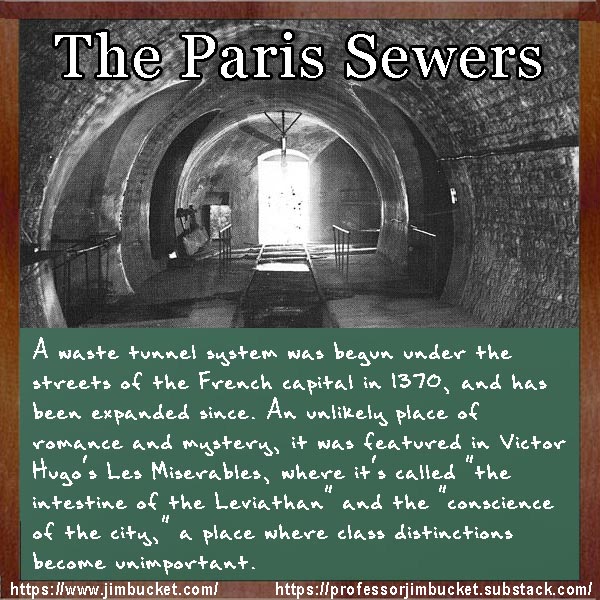
The Paris Sewers

THE PARIS SEWERS (Paris, France)

A waste tunnel system was begun under the streets of the French capital in 1370, and has been expanded since. An unlikely place of romance and mystery, it was featured in Victor Hugo's Les Misérables, where it's called "the intestine of the Leviathan" and the "conscience of the city," a place where class distinctions become unimportant.

(Image courtesy Wikimedia Commons; CTTO)